
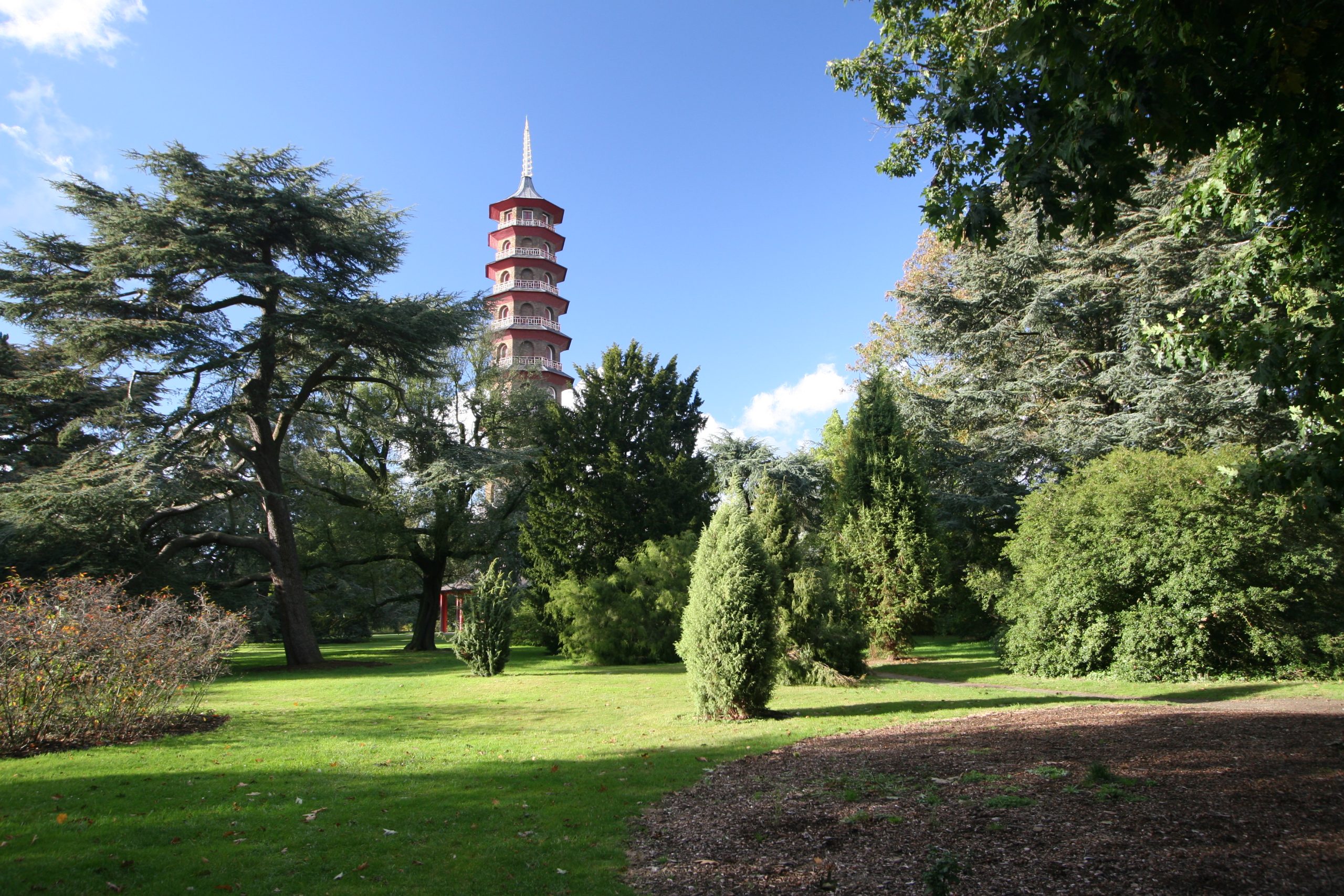
Featured image: the Great Pagoda rising above the trees at Kew Gardens, London.
Royal Botanic Gardens, Kew, usually known simply as Kew Gardens 🌳, is one of those rare places where science 🔬, beauty 🌺, and history 🏛️ quietly coexist. Sitting beside a gentle bend in the Thames 🚣♂️ in southwest London, Kew is not just a pleasant day out—it is one of the most important botanical institutions on Earth 🌍.
Kew’s story begins in the early 18th century ⏳, when the riverside estates at Kew and Richmond were fashionable retreats for royalty 👑. Its transformation into a serious botanical garden owes much to Princess Augusta of Saxe-Gotha, the mother of George III, who established a nine-acre botanic garden in the 1750s 🌱. What began as a royal passion project 💚 soon grew into something far more ambitious.
The turning point came with the Age of Exploration 🧭. Under the influence of figures such as Joseph Banks, who sailed with Captain Cook 🚢, Kew became the nerve centre of a global plant-collecting network 🌎. Seeds, cuttings, and specimens arrived from every corner of the British Empire and beyond 📦🌿. By the 19th century, under directors such as William Hooker, Kew evolved into a scientific institution with a mission: to understand 🤔, classify 🗂️, and conserve ♻️ the world’s plant life.
What makes Kew special is the sheer scale of that mission 💥. Today, the gardens and associated sites house around 50,000 living plant species 🌸🌲🌵, representing roughly one-seventh of all known plant life on the planet 🌍. Add to that the world-famous herbarium—containing over seven million preserved specimens 📚🍂—and Kew becomes less a garden and more a living library of global biodiversity.
Architecturally, Kew is just as distinctive 🏗️. Much of its 19th-century layout was shaped by Decimus Burton, whose elegant designs still define the landscape ✏️🌳. The great icons are the glasshouses: the soaring Palm House, a triumph of Victorian iron and glass engineering 🏛️✨, and the vast Temperate House, the largest surviving Victorian glasshouse in the world 🌡️🌿. These structures were revolutionary in their time, designed to recreate climates from across the globe long before climate control was taken for granted ❄️☀️.
In 2003 🗓️, Kew’s global importance was formally recognised when it became a UNESCO World Heritage Site 🏆. Yet it remains wonderfully human in scale 😊. You can wander from Japanese gardens 🎎 to alpine rockeries 🏔️, from tropical rainforest 🌴 to English woodland 🌳, all within a matter of minutes ⏰.
Kew Gardens is, at heart, a place of connections—between science and art 🎨🔬, empire and ecology 🌍🌱, past and future ⏳➡️🔮. In an age of environmental uncertainty 🌡️, it stands as both a celebration of plant life 🎉🌺 and a reminder of how much of it depends on careful stewardship 🤲🌍.
Getting to Kew
Getting to Kew is refreshingly straightforward 🚇. One of the nicest ways to approach the gardens is by taking the District line or Mildmay line (same tracks) westbound to Kew Gardens station. Unlike many London attractions, Kew has a dedicated stop just a short walk from the gates.
A particularly good way to turn the visit into a full-day excursion is to keep going once you’ve finished exploring the gardens 🚶♂️➡️🌊.
From Kew, it’s an easy and pleasant walk or single tube hop to Richmond, a natural place to linger.
Richmond is well suited to gentle pursuits: boating on the river 🚣♀️, an easy cycle ride 🚲, or simply sitting with a coffee and watching the water slide past ☕🌤️.
When it’s time to head back, trains from Richmond station depart every few minutes for London Waterloo. It’s worth avoiding the slower stopping services ⏳—the express trains take just under 20 minutes and usually stop only once at Clapham Junction, which is itself extremely handy for connections across South London. From Waterloo 🚉, the rest of the capital is effortlessly within reach by tube, making Kew feel both like an escape from London—and very much a part of it .
Getting to Kew Gardens from Heathrow
If you happen to have a few hours spare between flights at Heathrow Airport, or you’re arriving in London in the early afternoon for a flight the following morning, Kew Gardens makes an excellent and surprisingly stress-free way to spend that time 🌱. It offers fresh air, space, and calm—often welcome after a long flight—without feeling like you’re cutting things too fine.
By car, the journey from Heathrow typically takes around 25 minutes, depending on traffic 🚗. This works particularly well if you are planning to hire a car anyway, especially if your onward journey takes you towards the Cotswolds or further afield. A visit to Kew can slot neatly into the start or end of a road trip, breaking up travel with something genuinely restorative.
Parking at Kew is, however, limited, although by London standards it is reasonable at £9 per day.
If you don’t already have a hire car, travelling by public transport is very straightforward 🚇. The Piccadilly line provides the backbone of the journey. For the fastest connections, you can change onto a bus at South Ealing, which gives a quick and efficient link towards Kew. Alternatively, for the smoothest and simplest route, stay on the tube a little longer to Turnham Green and change there for the District line, which stops directly at Kew Gardens station. Either way, it’s an easy journey that turns airport downtime into something far more memorable 🌳.