
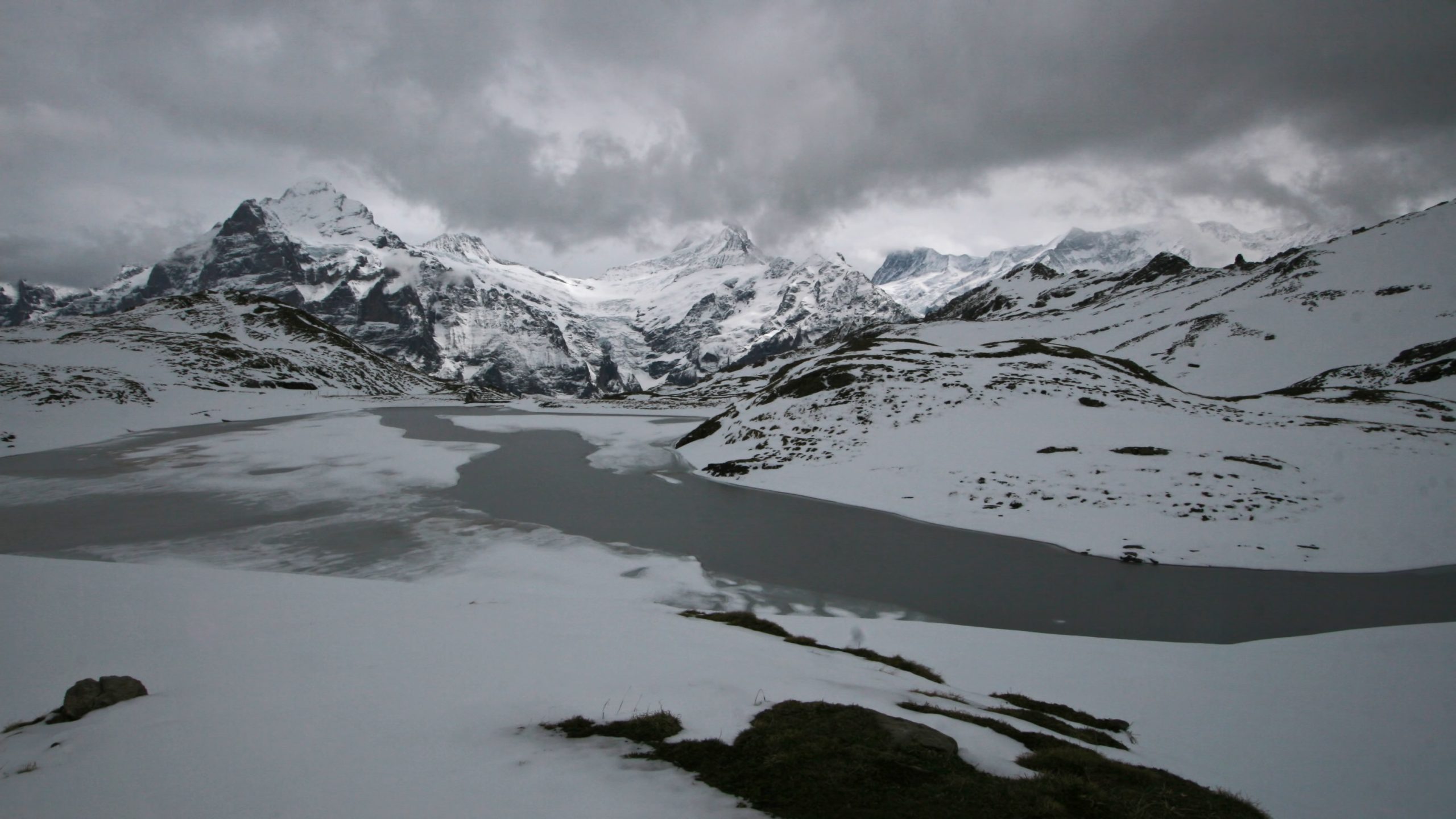
Featured image: The bleak alpine landscape of Jungfrau, Mönch and Eiger deep in a May afternoon, with the frozen waters of Bachalpsee in the foreground. The absence of people and the muted tones give the image an almost monochrome quality, despite being a colour photograph.
In mid-May 2007, I spent a few days in Interlaken, the gateway to the Bernese Oberland in the Swiss Alps. I remember that I really wasn’t feeling very well on this particular day, but I went out anyway, deep into the afternoon, and took the cable car up to First, from where it’s about an hour’s walk to Bachalpsee.
This photo looks completely bleak: frozen lake, snow underfoot, heavy cloud pressing down, and no one else around at all.
Whenever I look through my photos of Switzerland, this one still comes back to me. It’s possibly one of my favourite photographs I’ve ever taken. It’s certainly the only time I’ve taken a photo with a digital camera that looks entirely black and white, even though it is technically a colour image — something you can see when it’s enlarged up to a granular level.
I’ve only been back to Switzerland once since, and that was later in the same year. Much as I’d love to return to this exact spot in spring, on a brighter day when the ice had melted, or right in the heart of late summer when flowers appear in the meadows, the reality is that the next time I travel somewhere mountainous outside the UK, it will probably be the Norwegian fjords. That was a family road trip when I was sixteen, and I didn’t have a camera then.
The other European destination that really pulls at me, in terms of dramatic terrain, is Iceland.
AI Edits
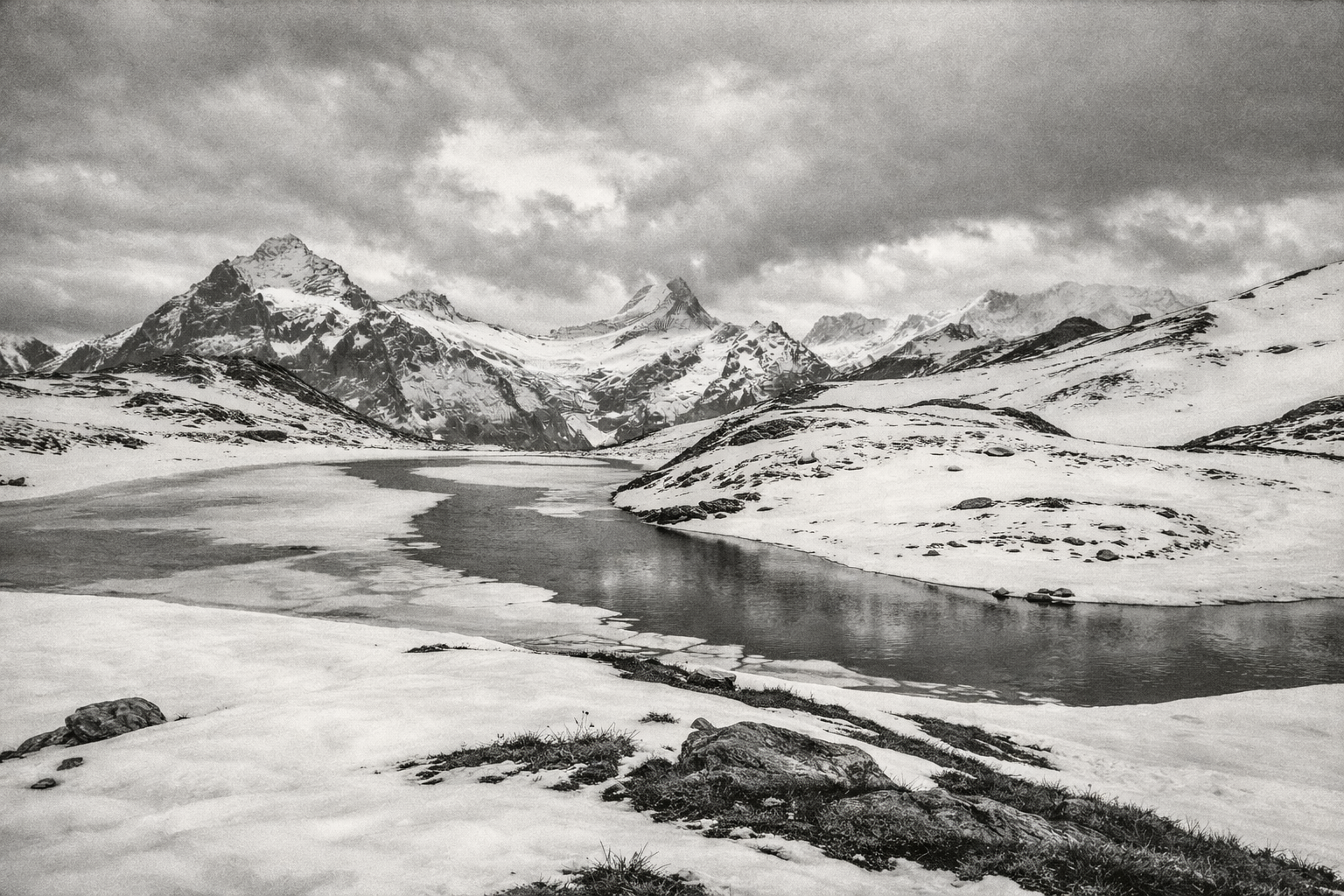
For now, at least, I can return to the same place through AI: imagining this scene as a harder black-and-white print on classic Ilford film:
Then shifting it into full colour to revisit Bachalpsee in June:
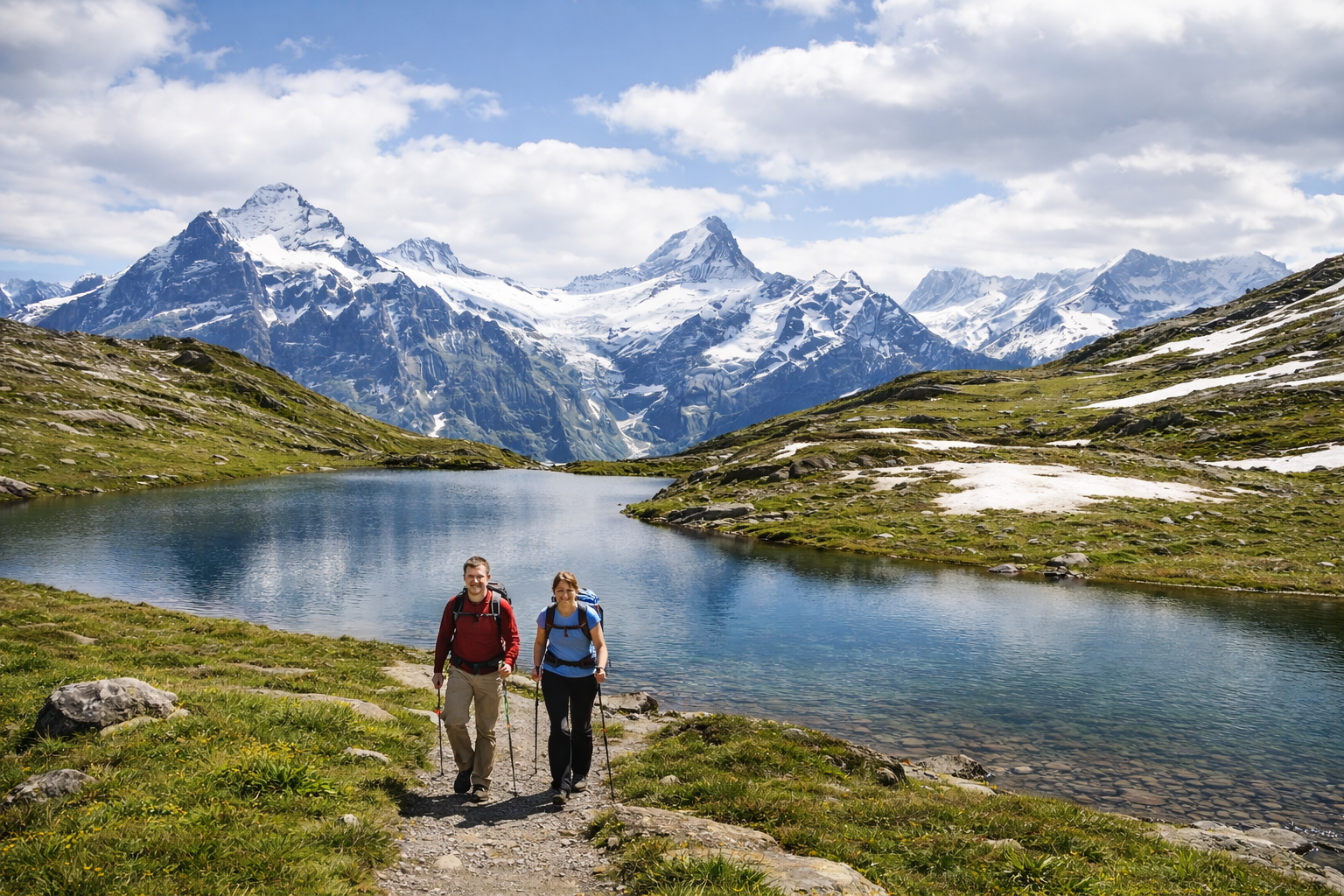
And again later in August, when the lake is still, the grass is green, and the high snowline has retreated to the peaks:
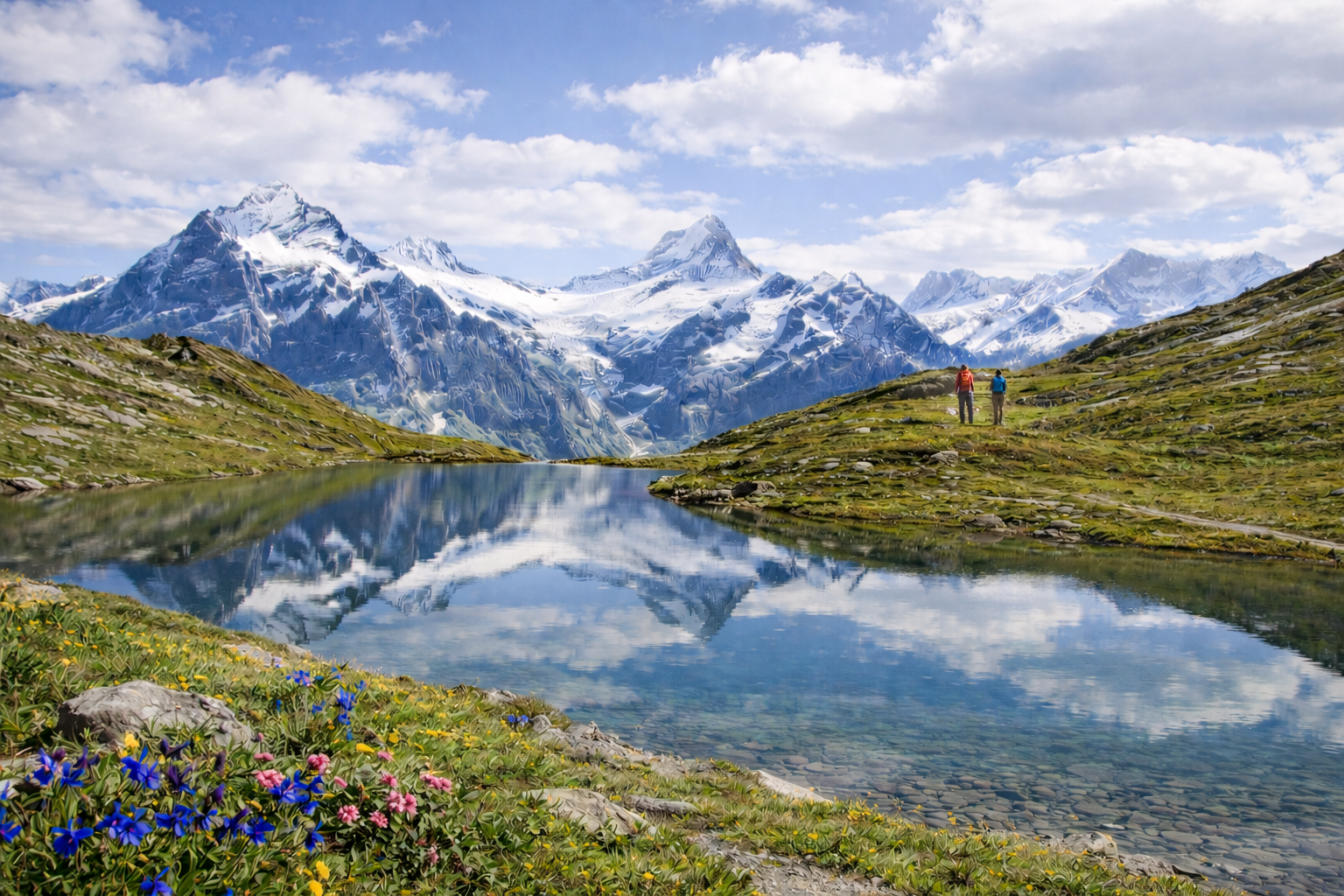
Getting to Bachalpsee is part of what makes the Bernese Oberland so special. Grindelwald is reached by train from Interlaken, which itself is connected easily across Switzerland, and also by direct trains to and from the German capital Berlin.
The nearest airport is Bern, but in practice it’s usually simpler to arrive via Zürich or Geneva. Zürich is slightly closer, though Geneva can sometimes offer better budget flight options.
Either way, once you arrive, you really don’t need a car. The Bernese Oberland is about as strong as it gets as a no-car destination — trains, cable cars, and footpaths doing all the work.