
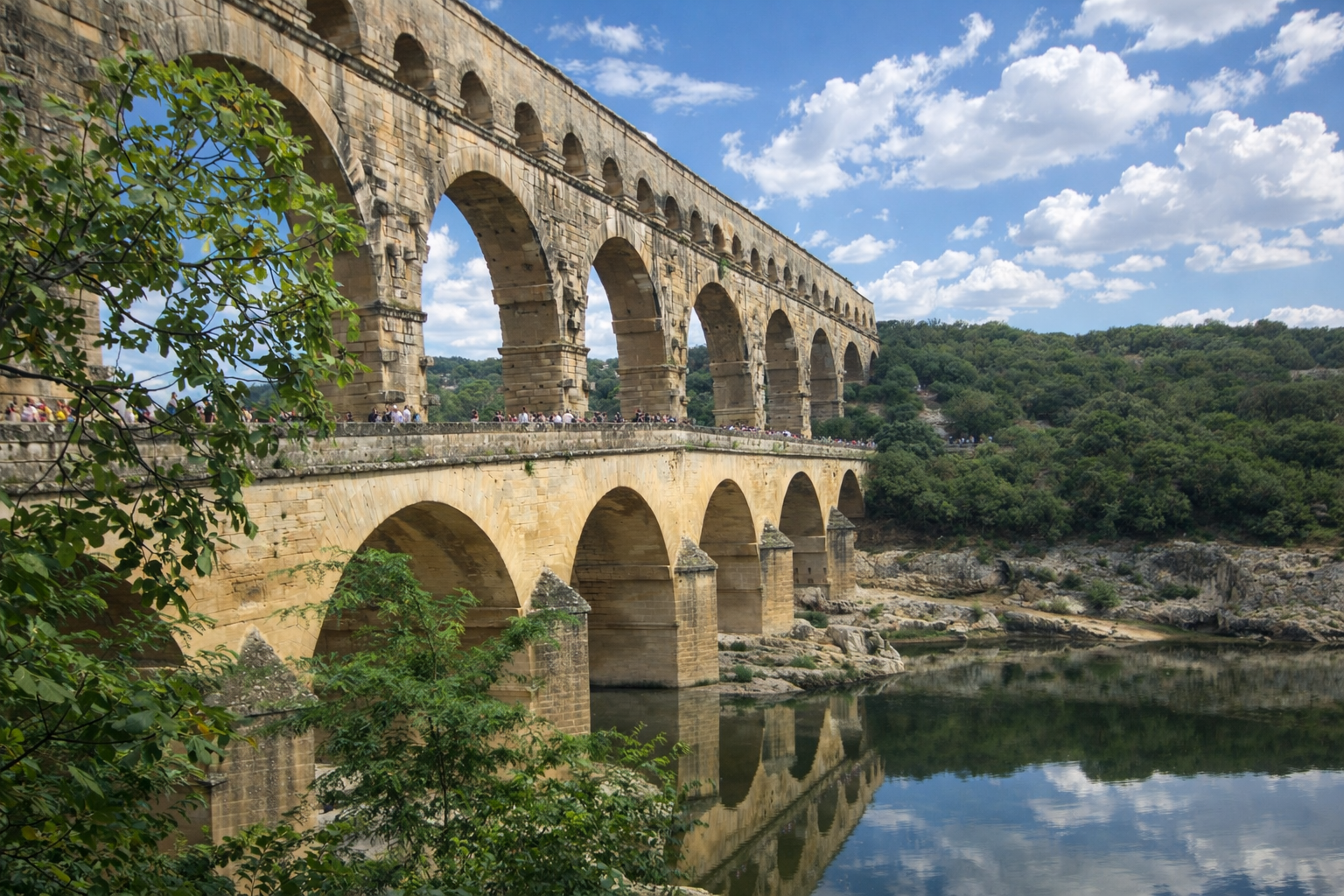
Featured image: The Pont du Gard near Nîmes, France – a UNESCO-listed Roman aqueduct crossing the Gardon River, built in the 1st century AD.
Visiting Pont du Gard by bus, one of the most impressive surviving Roman aqueducts in the world, is entirely possible without a car. Two regional liO buses — 115 and 121 — link Avignon, Nîmes, and the village near the site, making it easy to build a half-day or full-day trip from either direction.
Here are two simple itineraries: one starting in Avignon, one starting in Nîmes, plus ways to continue onward or return to where you began.
Getting to Pont du Gard by bus from Avignon or Nîmes isn’t quite as straightforward as you might expect, but it’s still perfectly workable — and genuinely rewarding — as a day trip.
🚍 Itinerary 1: Starting from Avignon
1. Avignon TGV → Avignon Centre → Avignon PEM
Begin by taking a short TER train (5–6 minutes) to Avignon Centre. From there, walk to Avignon PEM, the main bus station.
2. Bus 115 to Pont du Gard
-
Example departure: 11:40 from Avignon PEM
-
Arrival at Vers-Pont-du-Gard – Rond-Point Pont du Gard: ~12:15
The stop is just outside the main visitor zone, with a short pedestrian route leading into the site.
3. Time at Pont du Gard
Spend 1–3 hours exploring the bridge, the museum, walking trails, and river viewpoints.
4. Continue to Nîmes (recommended)
Catch Bus 121 towards Nîmes:
-
Typical departure: 13:52
-
Arrival in Nîmes: ~14:40–14:50
This is ideal if you want a relaxed afternoon and evening in Nîmes.
Or return to Avignon
Simply take a later 115 back from the same Rond-Point stop.
🚍 Itinerary 2: Starting from Nîmes
1. Bus 121 from Nîmes to Pont du Gard
-
Morning departures run a few times per day.
-
Journey time: ~45 minutes
You’ll be dropped at Rond-Point Pont du Gard, an easy walk to the visitor entrances.
2. Explore the Site
A comfortable visit takes 1–3 hours, but you can extend as long as you like within opening times.
3. Continue to Avignon
Take Bus 115, which runs eastwards toward Avignon.
You’ll arrive at Avignon PEM, and from there it’s a quick TER to Avignon TGV.
Or return to Nîmes
Just take the next 121, depending on whether you choose a shorter or longer stay.

Getting to Pont du Gard from Nîmes–Pont-du-Gard Station
Despite the name, Nîmes–Pont-du-Gard TGV station is a slight misnomer: although it is a little closer to the aqueduct than central Nîmes, there is no direct bus link from the TGV station to Pont du Gard. Travellers using public transport must first take a short regional train ride of about 10 minutes into Nîmes Centre, and then continue on Bus 121 to reach the site.
However, like most purpose-built TGV stations in France, car rental is available on-site, and the drive to Pont du Gard takes roughly 30 minutes, offering a flexible and practical alternative for visitors who prefer to travel independently.
❓ Why isn’t there a frequent shuttle bus?
🌉 1. Pont du Gard isn’t served by a dedicated “tourist bus”
The buses you’re using — liO lines 115 and 121 — are regional public transport routes, not services created for the Pont du Gard site. Their primary purpose is to connect towns and villages such as Avignon, Remoulins, Uzès, and Nîmes.
The Pont du Gard stop just happens to be on the way.
So the timetable follows the patterns of normal regional mobility, not tourist demand.
🎒 2. Regional routes in France are timed around school mobility
Across France, especially outside big cities, school mobility is the biggest driver of demand.
So regional bus lines often have:
-
School-day columns (circulation scolaire)
-
Holiday columns
-
Weekend / Sunday columns
This doesn’t mean the line only exists for schools — it just recognises that volumes shift massively when pupils aren’t travelling.
Pont du Gard is essentially “a bonus stop” on a rural commuter line.
📉 3. Tourist traffic is big at Pont du Gard — but diffuse
Tourists to Pont du Gard come by:
-
Car 🚗
-
Coach tours 🚌
-
Cycling routes 🚴
-
Occasional shuttle buses from hotels
-
Taxi or rideshare
The percentage arriving by regular public bus is tiny, so the region doesn’t justify a special, high-frequency route just for visitors.
🧠 4. The site itself doesn’t operate a municipal bus
Pont du Gard is run like a cultural park, not an urban attraction.
Its investment goes into:
-
The museum
-
Environmental conservation
-
Visitor trails
-
Events
Transport is left to the regional network rather than the site running its own shuttle.
🇫🇷 5. Getting to Pont du Gard by bus is actually typical of rural France
Even other very well-known sites — like Gordes, Roussillon, Saint-Guilhem-le-Désert, parts of the Loire, or Mont Ventoux — have public buses that:
-
Run infrequently
-
Stop completely on Sundays
-
Follow school calendars
France’s rural public transport is brilliant… when students need it 😉.
🌞 The good news
Even with school-term variations, the Pont du Gard connection works reliably all year, as long as you:
-
Look at the correct column for your date
-
Match bus 115 → Pont du Gard → bus 121
🚄 Getting to Pont du Gard by bus from Avignon or Nîmes + TGV Trains
Visiting Pont du Gard also works brilliantly as part of a wider rail itinerary. While the link between Avignon and Nîmes is fast, it isn’t a TGV service — it’s a regional train that runs via Nîmes-Pont-du-Gard TGV station, effectively creating a quick, convenient shuttle between the two cities.
The real long-distance value comes from the TGV services at Avignon TGV and Nîmes-Pont-du-Gard, which provide high-speed connections to Marseille, Lyon, Montpellier, Paris, and other major hubs. These cities all offer far better flight options than Nîmes, and Avignon currently has no scheduled passenger flights, making the TGV the best way to connect your Pont du Gard visit with onward travel. This means you can still enjoy a very easy triangle — Avignon → Pont du Gard → Nîmes → Avignon — while using the TGV network for the bigger jumps across France and Europe.
🚆 Linking Onwards to Arles and Van Gogh Country
The same regional train that connects Avignon and Nîmes — running via Nîmes-Pont-du-Gard TGV — also continues directly to Arles, a city celebrated for its deep associations with Vincent van Gogh. This makes Arles an effortless extension of your trip, and it’s even a convenient transfer point on some services between Avignon and Nîmes.
From Arles, you can continue onwards by rail or loop back to Avignon without difficulty. Travellers hoping to explore lavender landscapes and countryside scenes that inspired Van Gogh may find that a rental car gives the flexibility needed to reach the smaller Provençal villages. Alternatively, hiring bicycles is a pleasant, low-impact way to explore the region, and bikes are usually easy to rent in larger French towns and especially at or near major railway stations.