
Asia > 🇨🇳 China > Guangzhou (CAN)

🚆 🚌⛴️ Do you need to rent a car in Guangzhou ?
These scores are based on the quality of public transport and other travel options. If these are good enough to see the main points of interest, then you don’t strictly need to rent a car.



- For all transport modes, a score of 0 = very poor or none available; 10 = outstandingly good.
💰💶💳 Is it worth hiring a car in Guangzhou?
These scores reflect the practical factors that affect whether renting a car is convenient, good value, and stress-free.

- For all factors, a score of 0 = very poor; 10 = outstandingly good
Guangzhou Car Rental Costs
Price bands:
- From 1 ($0-10 per day) to 10 ($90-100 per day);
- For typical cheapest available economy hire car;
- Jan - Mar 2027 / Apr - Dec 2026.
- Prices correct as of Feb 2026 - estimates only, not a guarantee.
📍 Getting Around Guangzhou — the Reality
Guangzhou is huge, dense, and fast-moving.
-
Multiple city centres and business districts
-
Extremely high population density
-
Heavy traffic throughout much of the day
-
Complex road layouts and restrictions
Despite its size, the city functions very effectively without private cars.
🚇 One of China’s Best Metro Systems
Guangzhou’s metro is the backbone of urban transport.
-
Extensive network covering almost all districts
-
Very high frequencies
-
Clear signage, including English
-
Direct connections to major rail stations and the airport
For visitors, the metro is usually faster, cheaper, and more predictable than driving.
🚆 High-Speed Rail and Regional Connectivity
Guangzhou is a major hub for China’s rail network.
-
High-speed trains to Shenzhen, Hong Kong, Wuhan, and beyond
-
Frequent intercity services
-
Large, well-connected stations
This makes it easy to move around the wider Pearl River Delta without a car.
🚄 The Pearl River Delta as One Integrated Rail Region
🌏 One Megaregion, Many Cities — One Rail System
The Pearl River Delta increasingly operates as a single, integrated rail unit rather than a collection of separate cities. From Macau and Zhuhai in the west, the network runs clockwise through Guangzhou, Dongguan, and Shenzhen, before reaching its eastern terminus in Hong Kong. High-frequency regional rail, intercity services, and high-speed lines bind the region together so tightly that travelling between cities often feels more like moving between neighbourhoods of a single vast metropolis.
🚋 Layered Transport That Just Works
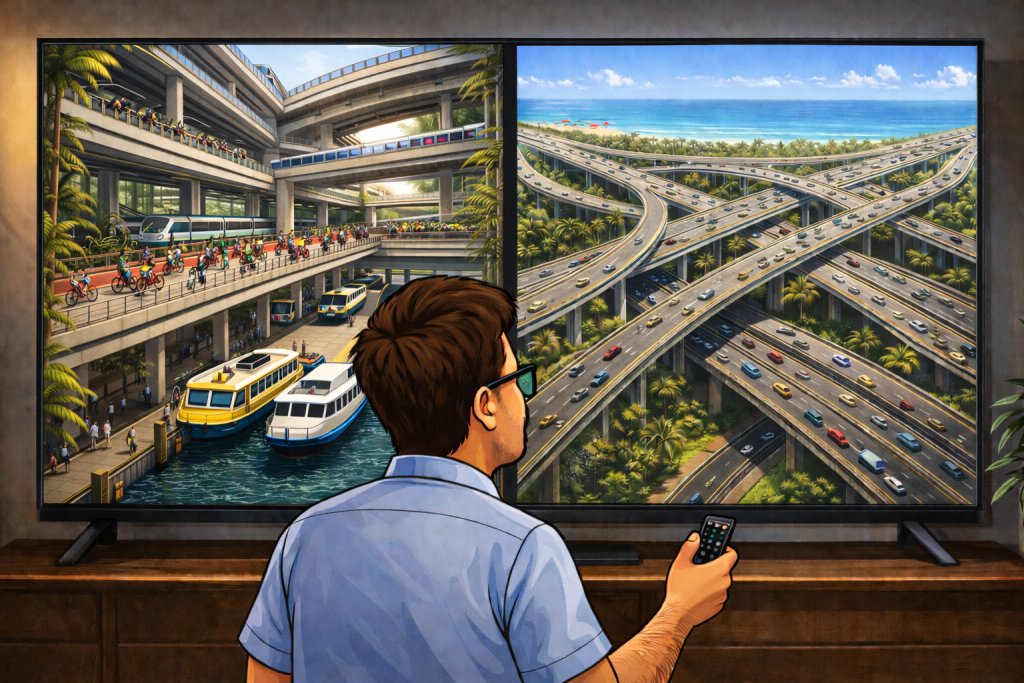
What makes the Pearl River Delta exceptional is how different transport layers interlock seamlessly. In Hong Kong, trams feed into the Metro 🚋➡️🚇. The Metro connects directly with regional rail, which in turn links effortlessly to intercity and high-speed services 🚆. This cascading structure means passengers can move smoothly from local streets to long-distance rail without disruption, ticketing friction, or awkward transfers.
🚆 Why Cars Fade Into the Background
Because these systems are designed to work together, private cars become largely unnecessary for regional travel 🚫🚗. Whether commuting, sightseeing, or crossing borders within the delta, rail is usually faster, more predictable, and easier than driving. The result is one of the world’s most coherent mega-regional transport systems — and a powerful example of how scale, density, and integration can make rail the default choice for millions of daily journeys.
🚍 Buses, Walking, and Urban Mobility
Above ground, buses and walking fill remaining gaps.
-
Dense bus network
-
Good last-mile coverage
-
Walkable areas within districts once you arrive
Most sightseeing involves short walks linked by metro rides.
🚗 Why Renting a Car Is Usually a Bad Idea
-
Severe traffic congestion
-
Limited and expensive parking
-
Navigation challenges
-
Restrictions and enforcement unfamiliar to visitors
A rental car is more likely to slow you down than help.
🚗 When a Car Might Make Sense
A car is only worth considering if:
-
You’re travelling well outside the city into rural Guangdong
-
You have a highly specific, non-urban itinerary
-
Transport is pre-arranged with a driver
Even then, hiring a car with driver is more common than self-drive.
Conclusion: should you rent a car in Guangzhou?
No — public transport is vastly better.
Guangzhou’s metro, buses, and rail connections make it one of the easiest mega-cities in the world to navigate without a car. Driving adds cost, stress, and delay without meaningful benefit.
💡 Rule of thumb:
Metro in Guangzhou. Trains for the region. Skip the car. 🚇🚆
[snic-cn row=”342″]
Search for Car Rental in Guangzhou with Economy Bookings .com
🚗 ✅ ❌ Summary Table
This summary score brings together how much you really need a car, whether it’s worth it, and an overall recommendation.






Frequently Asked Questions

|
Visited? – Have we visited Guangzhou in person (year)?
N/A
|
|
Updates – When was this page last updated:
|
|
What are the general advantages and disadvantages of renting a car in any location?
|

|
I'm still not sure whether or not to rent a car in Guangzhou –
can you offer more advice?
|

|
Can you advise us on how to get the best car rental deal in Guangzhou?
|
👍🏾 / 👎🏻 Will You Rent a Car in Guangzhou?
 Would you rent a car in Guangzhou, or would you rely on tours or public transport instead?
Everyone travels differently, and the right choice often depends on where you’re going, how long you’re staying, and what kind of trip you’re planning.
Would you rent a car in Guangzhou, or would you rely on tours or public transport instead?
Everyone travels differently, and the right choice often depends on where you’re going, how long you’re staying, and what kind of trip you’re planning.
Hopefully this page has given you a quick, practical overview of the pros and cons of renting a car in Guangzhou, and whether it’s really necessary or not. Maybe it’s helped you make up your mind — or maybe you’ve already visited and have insights to share.
We always welcome comments, questions, and comparisons with other cities.
All feedback is read, and any questions or clarifications are usually replied to within 24 hours.