
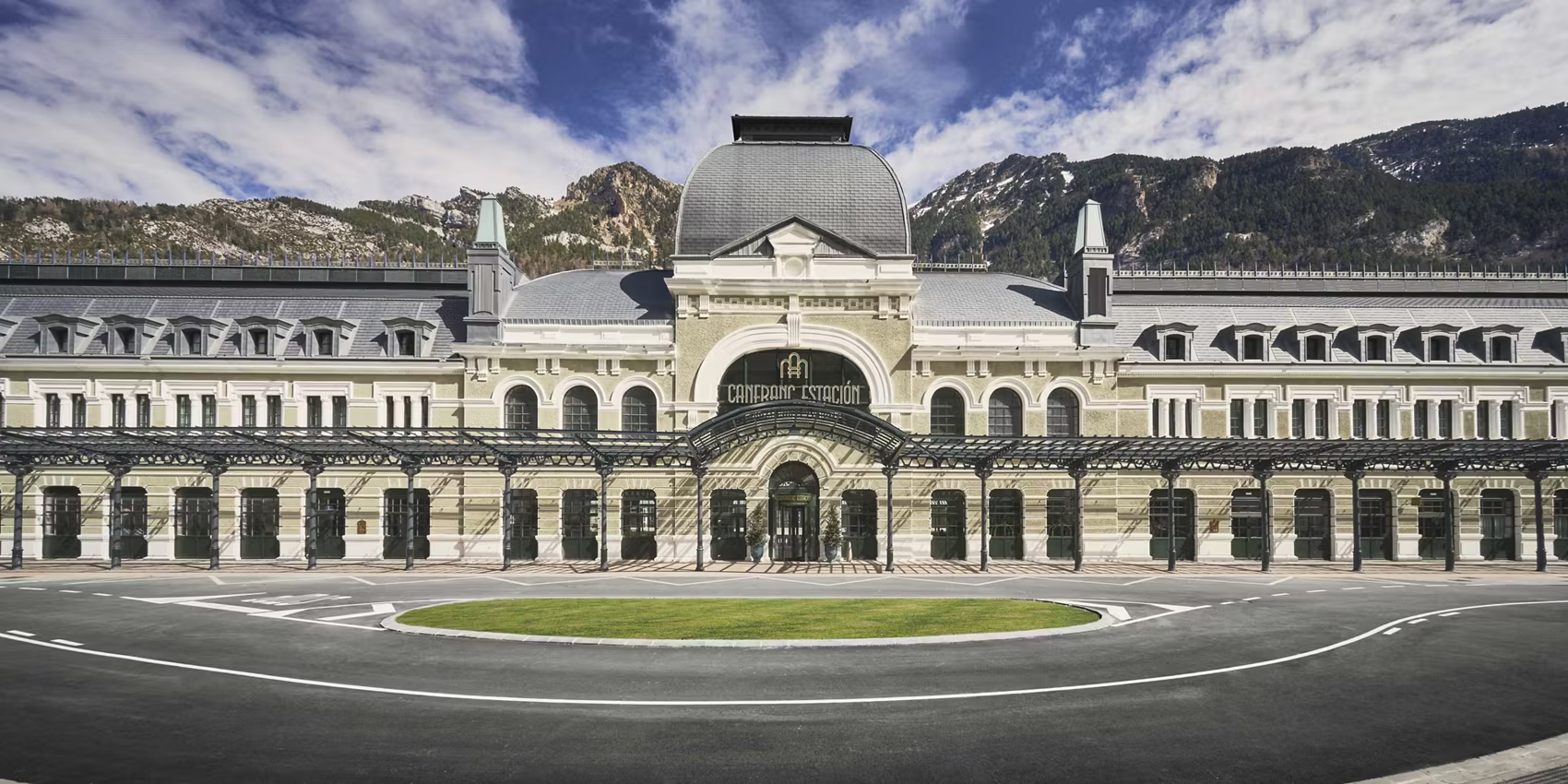
Image (C) Barcelo Hotels
Canfranc Estación
Set high in the Spanish Pyrenees near the French border, Canfranc Estación, a Royal Hideaway Hotel occupies one of the most extraordinary railway buildings in Europe. Opened in 1928, the vast station was designed as a grand international interchange between France and Spain, complete with customs halls, hotel facilities, and platforms that once handled long-distance trains crossing the mountains. The ambition far outstripped reality, and after the international line closed in 1970, the building fell into decades of decline before being meticulously restored as a luxury hotel aimed at high-end tourism rather than everyday rail travel.
Reaching Canfranc by train from Zaragoza
Today, rail access to Canfranc has returned — but in a much more modest form. Zaragoza is the key rail gateway, with typically two Renfe Media Distancia trains per day running directly to Canfranc. The journey takes around 3 hours and 20 minutes, climbing steadily through Aragón and into the mountains. These are conventional regional services rather than high-speed trains, and frequencies are limited, so planning around departure times is essential.
Getting to Zaragoza by air or high-speed rail
Zaragoza itself has a limited range of direct flights, including services operated by Ryanair from (Milan) Bergamo, (Brussels) Charleroi, and London Stansted, and Wizz Air from Rome. Outside these routes, most travellers reach Zaragoza by rail instead. Fast AVE high-speed trains run directly from Madrid and Barcelona, making Zaragoza an easy stop on Spain’s main north–south and east–west rail axes.
The closed French link and the long way round
Historically, Canfranc was directly connected to France through the Somport Tunnel, linking Aragón with the Aspe Valley. That cross-border line once continued towards Bedous, but it remains closed on the French side. As a result, travelling purely by rail from the French Pyrenees now involves a long clockwise loop via Toulouse, Narbonne, Perpignan, Barcelona, and Zaragoza. In practice, this can take around 18 hours, involve four or five changes, and usually requires an overnight stay in Zaragoza to make the timings work.
Using French Pyrenees cities as stepping stones
Despite this, the rail route can still be woven into a broader itinerary. Travellers already exploring the French Pyrenees may find it practical to break the journey in cities such as Pau or Lourdes, or in Toulouse or Perpignan before continuing into Spain. In that sense, Canfranc can still be reached as part of a slow, rail-focused journey — but it requires patience, flexibility, and a willingness to treat the journey as part of the experience.
The honest conclusion: driving is often the simplest option
Ultimately, for many visitors travelling around the French Pyrenees, driving to Canfranc remains the most practical option, even if it feels like admitting defeat in the face of such a monumental railway structure. The road journey from Bedous to Canfranc takes around 45 minutes, crossing the border directly and bypassing the long rail loop entirely.
For a hotel that was once conceived as a symbol of international rail travel, it’s an irony that arriving by car is now often the simplest way to experience one of Europe’s grandest stations — reborn not as a hub, but as a destination in its own right.