
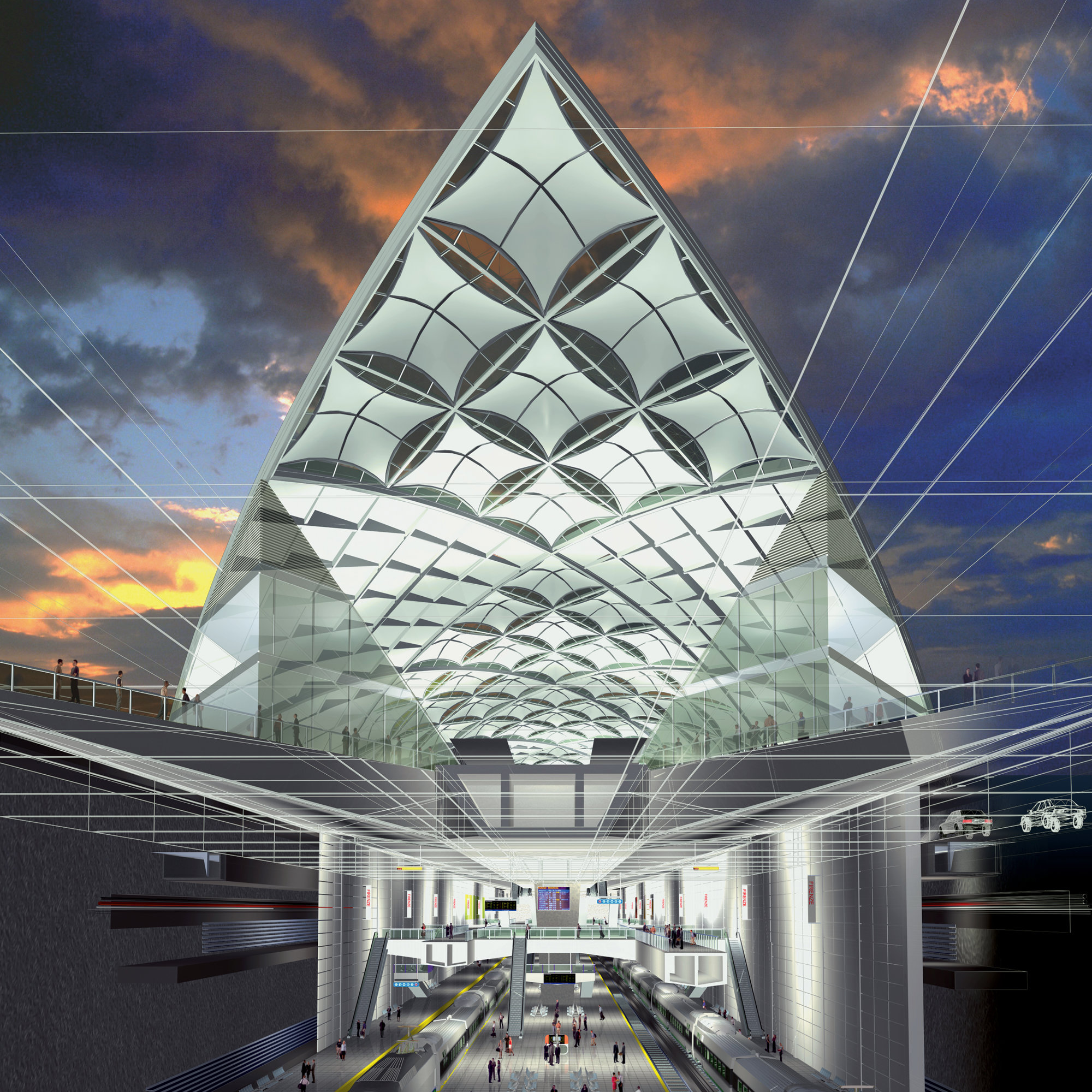
Image (C) Foster + Partners
Florence is one of Europe’s most rail-dependent cities, sitting squarely on Italy’s north–south high-speed axis. Yet for years, travellers have heard about a new high-speed railway station that somehow never seems to open. So what actually happened to Florence’s planned high-speed station — and why do high-speed trains still arrive at Santa Maria Novella?
The short answer is that the project never disappeared. It became one of Italy’s most complex, delayed, and politically sensitive infrastructure schemes.
Florence’s Rail Problem Was Always Structural
Florence’s main station, Santa Maria Novella, is a terminus, not a through station. High-speed trains entering the city must slow down, stop, and reverse direction before continuing north or south. That works — but it limits capacity, creates knock-on delays, and constrains future growth on Italy’s busiest rail corridor.
For decades, planners agreed on the solution: remove high-speed traffic from the surface station entirely and send it underground on a dedicated bypass, with a new station designed specifically for through-running services.
The Belfiore Station Vision
The proposed solution became known as Firenze Belfiore, a new underground high-speed station located north of the historic centre. Crucially, it was designed not as a replacement for Santa Maria Novella, but as a complement — allowing regional and conventional trains to remain at surface level while high-speed services pass beneath the city.
The architectural design was awarded to Foster + Partners (FAP), whose scheme emphasises:
-
Deep underground platforms for high-speed trains
-
A large, light-filled concourse above
-
Minimal visual impact on Florence’s historic fabric
In theory, it was an elegant solution: invisible where it needed to be, highly functional where it mattered.
Why Did It Take So Long?
The delays weren’t due to a single failure, but a stacking of problems:
-
Political changes at local and national level
-
Funding uncertainty and redesigns
-
Legal challenges and environmental concerns
-
Extraordinary engineering complexity beneath a historic city
Florence sits on sensitive geology, with archaeological layers, groundwater issues, and strict preservation rules. Boring long tunnels under the city while protecting centuries-old structures was always going to be slow — and risky.
At several points in the 2010s, the project appeared stalled entirely, leading many to assume it had been quietly abandoned.
What’s Actually Happening Now?
In reality, the project was restarted and restructured rather than cancelled. Tunnel-boring operations resumed, and major excavation work has been progressing beneath Florence in recent years. The station itself is still under construction, and it is not yet open to passengers.
As things stand:
-
High-speed trains still use Santa Maria Novella
-
The underground bypass and Belfiore station are incomplete
-
Opening is expected later in the decade, rather than imminently
In other words, the station didn’t fail — it just moved on Italian infrastructure timescales.
Why Florence Still Feels “Unfinished” on the High-Speed Network
Florence remains the largest city on Italy’s high-speed network without a dedicated through station. Until Belfiore opens, Florence will continue to act as a bottleneck between Bologna and Rome, even though the rest of the route is fully optimised for high-speed running.
When the station finally opens, the impact should be significant:
-
Faster north–south journeys
-
Increased service frequency
-
Reduced congestion at Santa Maria Novella
-
Better separation of regional and high-speed traffic
But until then, Florence remains a paradox: a global tourist city with world-class rail demand, still waiting for its modern high-speed solution to fully arrive.
So… What Did Happen?
Nothing dramatic — and that’s the point.
Florence’s new high-speed station didn’t collapse, get cancelled, or get replaced. It became a slow-burn megaproject, shaped by politics, archaeology, engineering, and caution. Designed by Foster + Partners, buried deep beneath one of Europe’s most sensitive historic cities, it is progressing — just far more slowly than anyone originally imagined.
For now, Santa Maria Novella carries on doing a job it was never designed for. And Florence waits.