
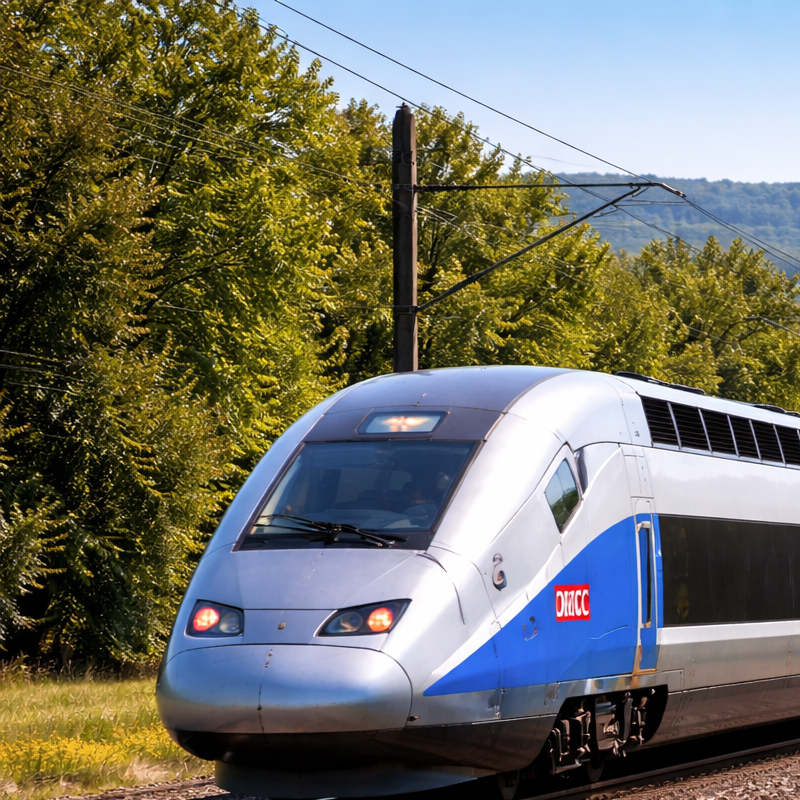
(AI generated image, prompt – “French TGV train”)
Toulouse: a transport city built for the air, not the rails
Toulouse is one of Europe’s most important transport cities — but its global reputation is rooted firmly in aviation, not rail ✈️. As the home of Airbus and a major aerospace research hub, the city is synonymous with aircraft design, testing, and manufacturing. That contrast often surprises visitors who expect a city so focused on transport technology to be equally dominant on the rail map.
However, the absence of a high-speed rail line has nothing to do with any lack of enthusiasm for trains. Toulouse’s rail position is the result of geography, distance, and timing rather than policy or preference.
Geography, distance, and the Paris-centred LGV network
Toulouse remains the largest major French city not yet connected to the LGV network, and it is also the most distant from Paris. France’s high-speed rail system was designed first around shorter, high-demand corridors radiating from the capital, where journey time savings were greatest for the lowest cost.
By contrast, Toulouse sits far to the southwest, outside the natural early expansion routes of the LGV. Reaching it requires long new infrastructure across sparsely populated areas, making the cost–benefit equation more complex than for cities closer to Paris.
The Bordeaux–Toulouse LGV: finally closing the gap
That situation is now beginning to change. The LGV Bordeaux–Toulouse project is under consideration and will, for the first time, connect Toulouse directly to the high-speed rail network. Once completed in the early 2030s, it will significantly reduce journey times to Paris and integrate Toulouse more fully into the national system.
Importantly, this line connects Toulouse via Bordeaux, rather than through a direct Paris radial, reflecting how the LGV network is now expanding laterally as well as outward from the capital.
Why there is no fast line east toward Narbonne
Where expectations often run ahead of reality is east of Toulouse. There has long been a vision of a high-speed corridor linking Toulouse to Narbonne, Montpellier, and onward to Spain — but the Toulouse–Narbonne high-speed line remains unbuilt.
While the project exists on paper, it is not currently funded or scheduled. As a result, eastbound journeys still rely on classic lines, typically involving a straightforward and reliable change at Narbonne rather than a continuous high-speed route.
Rail services from Toulouse are better than many expect
Despite the lack of a full LGV connection today, rail services from Toulouse are far stronger than the map suggests 🚆. The city has fast and frequent connections to Bordeaux, Lourdes, Pau, and Paris, and works efficiently as a hub for southwest France.
Once you reach Bordeaux or other LGV-connected cities, high-speed onward travel is seamless. In practical terms, Toulouse already functions well within the national rail network — even if it has had to wait longer than most cities to join the high-speed core.
Not anti-train — just late to the network
In short, Toulouse’s high-speed rail gap is not ideological, and it is certainly not anti-train. It is the product of distance, sequencing, cost, and terrain in one of Europe’s most ambitious rail systems.
As the LGV network continues to extend, Toulouse is finally moving from the edge towards a key position on France’s high-speed rail map 🚄 — even if its journey there has taken longer than almost anywhere else.