
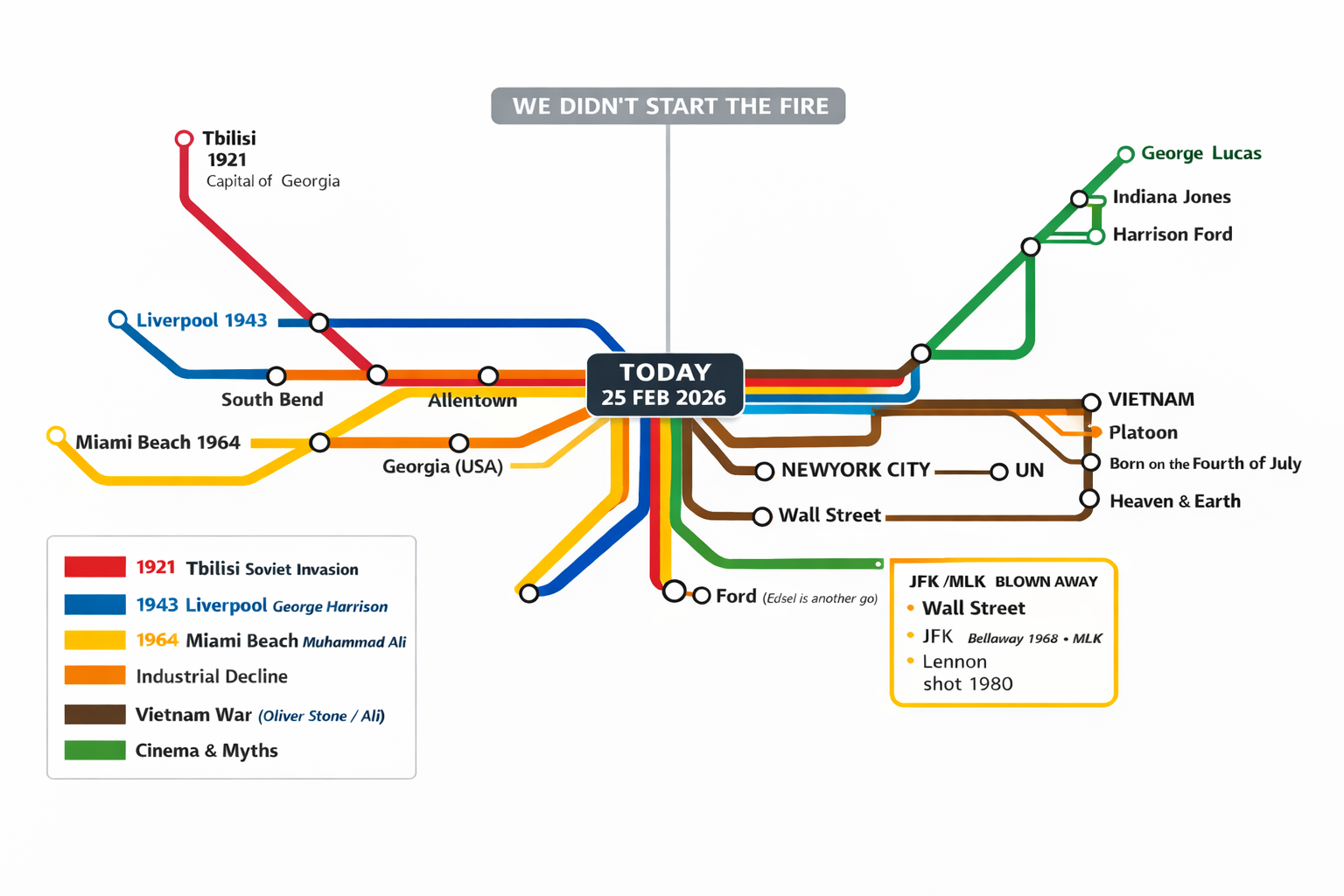
This is the first blog post about link salads, which will provisionally sit on their own blog at some point in the not too distant future.
A link salad is a structured stream of consciousness. It starts from a fixed anchor — usually a date — and follows associations across people, places, events, songs, films, and ideas. What matters is not linear chronology, but pattern recognition.
The framework uses COGs:
-
Characters (people)
-
Objects (things)
-
Geography (places)
-
Stories (timelines)
Links are formed using three simple actions:
-
MOVE – shifting sideways to something related
-
ZOOM – changing scale, from individual to city to world etc
-
SNAP – fast associative jumps (names, symbols, themes)
The aim is not a straight line but a network of loops, where ideas return, overlap, and reinforce one another.
History as a background condition
Like many dates, 25 February sits on top of much older forces. One of today’s strongest anchors lies outside the period usually associated with Billy Joel’s We Didn’t Start the Fire — and that’s important.
On 25 February 1921, Soviet forces invaded Tbilisi, the capital of Georgia. This moment doesn’t belong to the Cold War proper; it precedes it. It represents Russian expansion and imperial consolidation before the ideological standoff of the later 20th century had fully formed.
This matters because it reminds us that many of the events later catalogued in We Didn’t Start the Fire are effects, not causes. The fire was already burning long before it had a soundtrack.
1943: Liverpool and cultural export
The next anchor is 25 February 1943, the birth of George Harrison in Liverpool.
Harrison’s birth itself sits outside the 1949–1989 frame of We Didn’t Start the Fire, but his cultural significance does not. British Beatlemania, and the Beatles’ transformation into a global cultural force, belongs squarely to the post-war world the song evokes.
Liverpool becomes a powerful geographic and cultural node:
-
a port city shaped by war and industry
-
a source of music that travelled outward to the United States
-
a place whose influence far exceeded its size
From Harrison, the links multiply, but not without strain: the Beatles, global pop culture, and later New York, where John Lennon would be shot dead in 1980. Another shock. Another unfinished story.
1964: Ali, Liston, and the media age
The third anchor brings the date fully into focus.
On 25 February 1964, Muhammad Ali defeats Sonny Liston in Miami Beach. The fight marks a media rupture — boxing as spectacle, identity, and politics — but it’s important to be precise about how this intersects with We Didn’t Start the Fire.
The song references Liston beating Patterson, not Ali beating Liston. That earlier bout represents the old order of heavyweight boxing. Ali belongs downstream of that reference: louder, more political, and impossible to contain.
Ali’s real historical weight emerges not just from the ring, but from what follows.
Vietnam: ignition and refusal
Vietnam is one of the strongest overlaps between today’s links and We Didn’t Start the Fire, and here the song is explicit.
Billy Joel names:
-
“Dien Bien Phu falls” — the 1954 French defeat that truly ignites the conflict
-
Ho Chi Minh — personifying the struggle
Vietnam is therefore a primary WDSTF theme, not a stretch.
Muhammad Ali’s refusal to fight in Vietnam on grounds of conscience gives that theme a powerful moral extension. His stance aligns closely with Martin Luther King Jr. (Atlanta, just a different Georgia), whose presence in the song is indirect but structural — via the Little Rock, the Montgomery bus boycott and Ole Miss, rather than his name.
Ali does not appear in the song, but he inhabits its moral universe.
Vietnam on film: Oliver Stone’s loop
Vietnam becomes a major story node through Oliver Stone, whose three Vietnam-related films form a coherent trilogy of perspectives:
-
Platoon — the war as lived by soldiers
-
Born on the Fourth of July — the war brought home, broken and disillusioned
-
Heaven & Earth — the war from a Vietnamese civilian viewpoint
These films don’t resolve Vietnam; they circle it. They treat history as something contested, remembered, and reinterpreted — very much in the spirit of We Didn’t Start the Fire as a catalogue rather than an explanation.
Stone adds another loop through Charlie Sheen, who appears in Platoon and later in Wall Street. War abroad, money at home. Different arenas, same underlying pressures.
New York: memory, myth, and management
The Ali–Vietnam loop returns to New York through cinema.
Ali is portrayed decades later by Will Smith in Ali (2001), bringing a 1960s figure into 21st-century cultural memory. Smith is already strongly associated with New York through the Men in Black franchise, whose first three films are firmly anchored in the city.
By now, New York is heavily overdetermined:
-
John F. Kennedy (via JFK airport) — assassinated, endlessly reinterpreted
-
John Lennon — murdered in New York
-
Wall Street — money and power
-
The United Nations — (Live and Let Die, Paul McCartney) – global theatre
Billy Joel: resonance, loss, and decline
Throughout today’s link salad, Billy Joel sits in the background not as a narrator, but as a kind of tuning fork. We Didn’t Start the Fire resonates quietly rather than dominating the structure. It doesn’t explain today’s links, but it helps them vibrate.
The song works as an index of post-war unease, selectively naming moments that feel unresolved rather than complete. Vietnam is central here, but the emotional weight of that conflict is carried more fully by another Joel song: Goodnight Saigon. Where We Didn’t Start the Fire lists, Goodnight Saigon mourns. It is about the loss of innocence, the slow realisation that something has gone badly wrong, and the quiet aftermath that follows the noise.
That sense of aftermath continues at home in Allentown, Joel’s portrait of industrial decay. Steel mills close, promises evaporate, and the optimism of post-war America gives way to fatigue and resentment. This domestic decline echoes a single, almost throwaway line in We Didn’t Start the Fire: “Edsel is a no-go.” The Edsel, famously a failed Ford sub-project named after Henry Ford’s son, becomes shorthand for misplaced confidence and collapsing industrial dreams.
That industrial loop widens geographically. South Bend, Indiana, home of Studebaker, represents another chapter in the same story: innovation without survival, factories without futures. From Indiana, a SNAP takes us to Indiana Jones, a fictional archaeologist forever digging through the ruins of past empires — a neat symbolic counterpoint to a state shaped by industrial rise and fall. The name coincidence is accidental, but the thematic overlap is not.
Joel’s New York State of Mind then pulls many of these threads back into a single place. New York becomes the city where the consequences of war, money, culture, and memory are felt most sharply. It is where industries are financed, wars are debated, myths are manufactured, and losses are absorbed. It is also where so many of today’s stories converge — politically, culturally, and emotionally.
Seen this way, Billy Joel’s songs don’t drive the link salad; they shadow it. They give emotional texture to the same forces already in play: Vietnam abroad, decline at home, and a country trying to understand what it has become.
That’s why Joel will almost certainly keep reappearing in future link salads — not because he explains history, but because he keeps noticing where it hurts.
U2 and the recurring fire
Those loops widen further through U2. MLK is a song in its own right. Pride (In the Name of Love) keeps his legacy alive. Angel of Harlem references JFK Airport on “a cold and wet December day, she touched the ground at JFK”. U2’s cover of Helter Skelter on Rattle and Hum snaps the loop back to the Beatles — and to George Harrison’s Liverpool roots, together with it’s strong maritime links to Dublin.
Explanation notes for the map
This map is best read as a mind map, not a geographically accurate transit diagram. Its purpose is to visualise associative loops rather than physical routes. Stations are arranged to reflect conceptual proximity — shared themes, historical resonance, or narrative continuity — rather than distance or direction.
The map is anchored on 25 February and deliberately fans out into three historical strata:
1921 (deep history), 1943 (wartime culture), and 1964 (media and civil-rights rupture). From those anchors, lines interweave through Characters, Objects, Geography, and Stories (COGS), using MOVE, ZOOM, and SNAP to show how ideas recur across domains.
-
The top-left of the map begins with Tbilisi and the Soviet invasion of 25 February 1921, establishing Russian/Soviet expansion as a precursor condition, not a Cold War event in itself.
-
The central cultural line begins in Liverpool in 1943 with the birth of George Harrison, linking British post-war culture to New York and later to cinema and myth-making.
-
The furthest left sporting/media anchor is Miami Beach in 1964, where Muhammad Ali (then Cassius Clay) defeated Sonny Liston, triggering the Ali → Civil Rights → Vietnam loop.
-
From there, Atlanta, Georgia becomes a moral junction via Martin Luther King Jr., linking civil rights, opposition to Vietnam, and later assassination narratives.
Colour coding is thematic rather than cartographic:
-
Orange = industrial decline
-
Brown = Vietnam and its consequences
-
Grey = historical accumulation / We Didn’t Start the Fire resonance
-
Blue / cinematic = film, myth, and cultural memory
Limitations of the map
There are several known limitations, and they are intentional rather than errors:
-
Geographical accuracy is not the goal. The map does not attempt to show correct east–west or north–south relationships. It is a cognitive layout, not an atlas.
-
Atlanta, Georgia appears twice. This is a limitation of the drawing tool rather than the concept. It reflects the city’s dual role as:
-
a civil-rights epicentre (MLK), and
-
a connective node between Ali, Vietnam opposition, and later cultural memory.
-
-
Some links are symbolic rather than causal (e.g. George Harrison → George Lucas → Harrison Ford). These are SNAP links based on names and shared mythic themes, not claims of influence.
-
JFK appears ambiguously:
-
as an assassination narrative,
-
as an airport (JFK),
-
and as a film (JFK), which itself spans Dallas, Washington DC, and New Orleans.
This ambiguity is deliberate and reflects how JFK functions in cultural memory.
-
-
The map does not correct every inconsistency because doing so would over-constrain the system. Link salads prioritise insight density over tidiness.
In short: this is a thinking tool, not a definitive model.
Map stations (bullet list)
Deep history / precursor
-
Tbilisi, Georgia
-
Soviet invasion – 25 February 1921
-
Russian/Soviet expansion as background condition
-
Wartime culture / music
-
Liverpool, England (1943)
-
Birth of George Harrison
-
British Beatlemania as post-war cultural force
-
-
New York City
-
Cultural destination for British music
-
John Lennon later killed here
-
Sport, media, and civil rights
-
Miami Beach, Florida (1964)
-
Muhammad Ali (Cassius Clay) defeats Sonny Liston – 25 February 1964
-
-
Atlanta, Georgia (USA)
-
Martin Luther King Jr.
-
Civil rights, moral opposition to Vietnam
-
(Appears twice on map – limitation of drawing tool)
-
Industrial decline (orange line)
-
Allentown, Pennsylvania
-
Steel industry decline
-
Billy Joel: Allentown
-
-
South Bend, Indiana
-
Studebaker automobile company
-
Symbol of Midwestern industrial collapse
-
-
Edsel (Ford sub-project)
-
Referenced in We Didn’t Start the Fire
-
Named after Henry Ford’s son
-
Vietnam War (brown line)
-
Vietnam
-
We Didn’t Start the Fire:
-
“Dien Bien Phu falls”
-
Ho Chi Minh
-
-
Moral opposition via MLK and Ali
-
Cinema and myth
-
George Lucas
-
Star Wars
-
Modern myth-making
-
-
Harrison Ford
-
Star Wars
-
Indiana Jones (SNAP link to Indiana)
-
-
Indiana Jones
-
Archaeology, empire, history as adventure
-
New York film & memory hub
-
Wall Street
-
Finance, power, capitalism
-
Oliver Stone film
-
-
Men in Black (franchise)
-
First three films set primarily in New York
-
Will Smith as myth-management figure
-
-
JFK
-
Assassination narrative
-
Airport reference (JFK)
-
Film spans Dallas & Washington DC
-
Why the map hasn’t been “corrected”
It would be perfectly possible to correct this map manually. Some duplication could be erased, labels could be rationalised, and certain nodes could be merged or repositioned to produce something cleaner and more formally consistent. That, however, is not the intention of this post.
This link salad grows out of an idea that goes back many years, long before the possibility of asking an AI to draw a map even existed. The decision to visualise it at all came out of a conversation earlier today, followed by some quick experimentation with ChatGPT face-to-face. From that point, I deliberately gave myself a two-hour window to produce both the blog post and the map. I’m now approaching the end of that time limit, and that constraint matters. What you’re seeing is not a polished cartographic artefact, but a snapshot of a thinking process captured in motion.
It’s also worth noting that the first version of the map attempted a much more classical, geographically literal interpretation. That approach didn’t work at all. It flattened the ideas, over-privileged physical accuracy, and lost the associative logic that the link salad depends on. The shift to a metro-style diagram was a breakthrough: not perfect, but far closer to how these ideas actually behave — as intersecting lines, hubs, and transfers rather than routes across a globe.
Why this hasn’t become a “proper” metro map
There are, of course, specialist tools designed specifically for building metro maps. Using one of those would allow for tighter control, clearer hierarchies, and fewer visual compromises. But those tools require the entire network logic to be finalised in advance. Every station, every line, every interchange has to be locked down before anything useful can be drawn.
That’s where the problem lies. In practice, this is an almost infinite exercise. The moment I start working manually — especially with pencil and paper — the map expands uncontrollably. New links suggest further links, which suggest further geographies, characters, objects, and stories. Before long, the entire world map is covered, and the original focus dissolves.
ChatGPT, by contrast, imposes a natural constraint. It can only work with a limited number of nodes at any one time, and what it produces reflects that limitation. The result isn’t a global rail system or a London Underground–scale network. It’s something closer to the kind of metro map you’d expect in a medium-sized city: dense enough to be interesting, bounded enough to remain legible.
That limitation turns out to be a feature rather than a flaw. It forces selection. It keeps the map readable. And it aligns neatly with the spirit of the link salad itself — not an attempt to map everything, but an attempt to notice which connections are active today, given a particular date, a particular mindset, and a finite amount of time.
In that sense, the map hasn’t been corrected because it isn’t finished — and it isn’t meant to be. It’s a working diagram, produced under constraint, reflecting the way ideas actually connect when you let them surface naturally rather than forcing them into a final form.
Why 25 February works
What makes 25 February such a strong link-salad date is the way it compresses recurring themes:
-
Empire and resistance
-
Culture emerging from war
-
Media moments that redefine identity
-
Conscience versus power
-
Vietnam as moral fault line
-
New York as the city where stories converge
The fire wasn’t started here.
But on this date, you can see exactly where it keeps flaring up.
That’s the link salad for 25 February.
Sitting alongside Car or no Car
The idea of producing link salads doesn’t compete with Car or no Car; it sits comfortably alongside it. At heart, the thinking is the same. With Car or no Car, the question is often: if I can get from A to B, how do I then extend that journey to C and D? Link salads ask a similar question, but in cognitive rather than physical space. Instead of identifiable trains running on fixed tracks, there are endless trains of thought, branching, looping, and reconnecting in ways that don’t require a timetable or a destination.
What has changed — and what makes this newly viable — is AI. Just as AI now makes it possible to research destinations, routes, and connections that would have been impractical even six months ago, it also makes it possible to generate patterns of links around any given date, theme, or open “COGS” prompt. Link salads close a long-standing loop between an interest in ground travel, an earlier fascination with flight-route networks, and the constraints of working with text and images inside ChatGPT. Those constraints, far from being a problem, actually provide a useful structure: a bounded system that surfaces points of interest rather than attempting to map everything.
A newspaper might list famous birthdays, national days, or historical events for a particular date. A link salad does something different. It brings those elements together and shows how they resonate. It can draw a common thread from George Harrison to Harrison Ford and George Lucas via Star Wars and Indiana Jones. It can place the US state of Georgia alongside the country of Georgia, not as a gimmick but as a meaningful historical coincidence on this date. In that sense, link salads don’t replace existing ways of presenting information — they reframe them, revealing connective tissue that is usually left implicit.